Degreed Multi-Persona Roleplays
Design
Extends Maestro's roleplay experience to let learners practice group conversations with multiple AI personas at once.
Learn More
CREDITS
Development
Pod 2 Eng Team
Product Management
Heather Shen
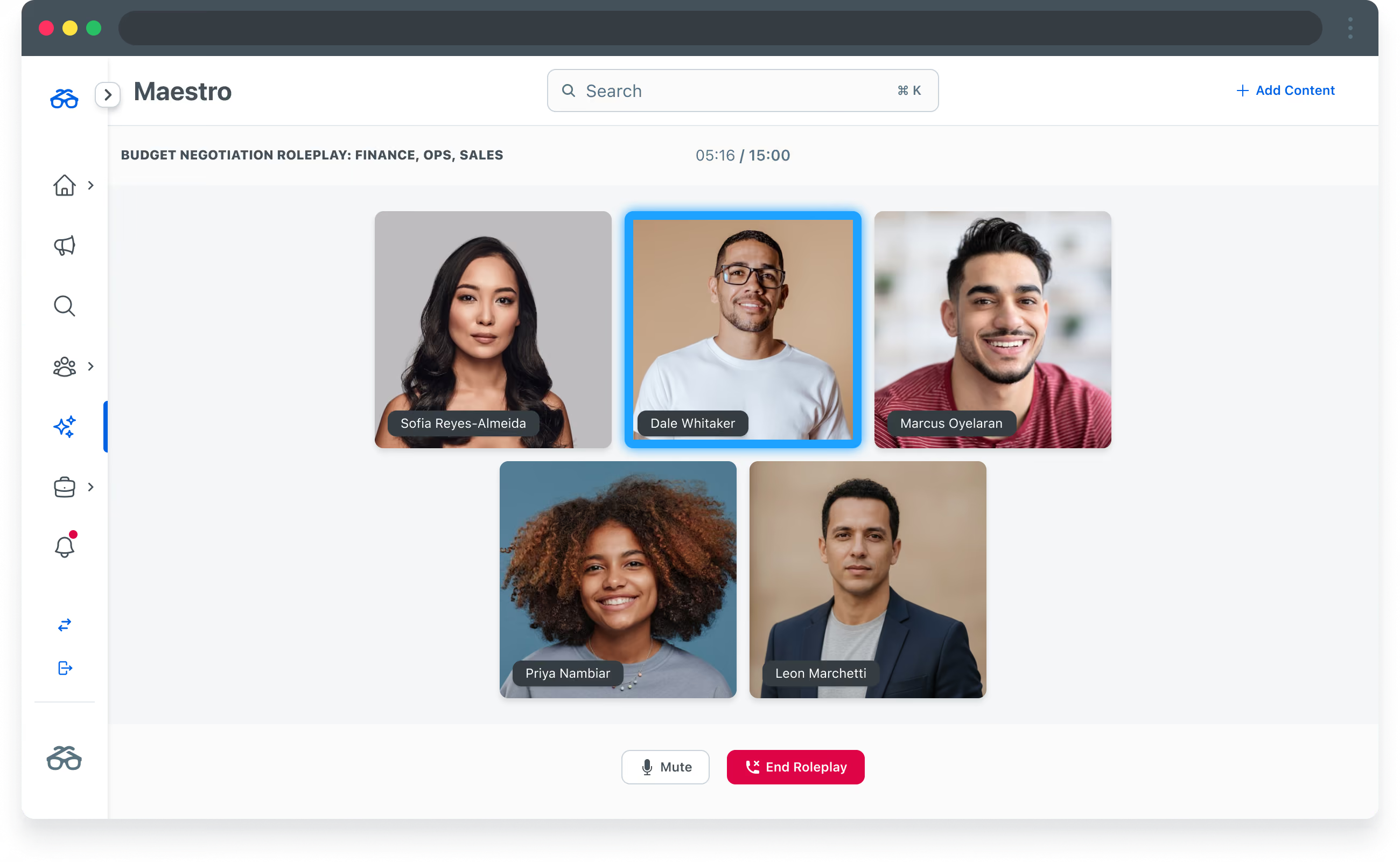
Extends Maestro's roleplay experience to let learners practice group conversations with multiple AI personas at once.
Maestro's roleplay simulations had always been built around one-on-one practice - a single learner, a single AI persona. But most of the real conversations people actually need to prepare for aren't one-on-one. Panel interviews, stakeholder meetings, sales calls with a full buying committee, these all involve reading and responding to multiple people with different priorities at the same time, and clients were asking for a way to practice exactly that.
The goal was to extend Maestro's roleplay format to support that kind of group dynamic, without losing what made the original one-on-one experience feel real and useful in the first place.

The existing chat interface was built for a single conversation thread between one learner and one AI persona - it didn't have a way to represent three or four distinct personalities talking, responding to each other, and competing for the conversation at once. Fitting multiple personas into that format risked feeling cluttered or confusing rather than realistic.
There was also a bigger question underneath the UI problem: realism. A roleplay only works as practice if it feels like talking to real people, not like prompting a chatbot. That meant rethinking the interface itself - moving away from a standard AI chat window toward something that felt closer to being in an actual conversation with a group.
Multi-Persona Roleplay shipped support for up to four AI personas in a single session. The chat interface was redesigned to resemble a video call rather than a text thread - each persona visually distinct, with a clear sense of who's speaking at any given moment - reinforcing the feeling of a real group conversation instead of an AI exchange. That same redesigned interaction model carries across both voice and text modes, so the realism holds regardless of how a learner chooses to practice.


